As a comparative gender and politics scholar, my research addresses questions about democracy and representation. Most importantly, my research asks: how does the exclusion or inclusion of women in politics advance or prohibit gender equality? I explore this question by comparing countries to each other to identify the conditions that need to be present for women in politics to have a positive impact on gender equality, such as the adoption of equitable parental leave or corporate board quotas. My area expertise is the OECD region with a specific focus on Germany, the United States, the United Kingdom, and Japan. Methodologically, I employ qualitative comparative analysis, qualitative content analysis, process tracing, surveys, and elite interviews in my research.

Gender and Representation
(2026) Och, M. “International Perspectives: Elected and Appointed Officials.” In The Sage International Encyclopedia of Politics and Gender, 771–79. SAGE Publications, Inc.
(2024) Franceschet, S., M. Och, and C. Xydias. “Gender, Family Status, and Parliamentary Careers in the German Bundestag.” Politics, Groups, and Identities (2024): 1–21
(2022) Ahrens, P., G. Abels, A. Jenichen, M. Och. “The 2021 Federal German Election – a Gender and Intersectional Analysis.” Politics 42(3): 249–266
(2022) Piscopo, J., C. Xydias, A. Atchison, M. Och. “Reproducing Hierarchies at the APSA Annual Meeting: Patterns of Panel Attendance by Gender, Race, and Ethnicity.” PS: Political Science & Politics 56(1): 61–68
(2021) Joshi, D. & M. Och. “Women Representatives, Left-Right Ideology and Gendered Pathways to Parliament in Asia and Europe.” Asian International Studies Review 22: 1–18
(2021) Joshi, D. & M. Och. “Early birds, short tenures, and the double squeeze: how gender and age intersect with parliamentary representation.” Politics, Groups, and Identities 9(3): 629–645
(2021) Och, M. “Women in Parliament: From Presence to Impact—Critical Actors in the Policy Making Process.” In Women, Power, and Political Representation, ed. Loewen, de Geus, & Tolley. University of Toronto Press
(2020) Och, M. “Manterrupting in the German Bundestag. Gendered Opposition to Female Members of Parliament?” Politics & Gender 16(2): 388–408
(2014) Joshi, D. & M. Och. “Talking about my generation and class? Unpacking the descriptive representation of women in Asian parliaments.” Women’s Studies International Forum 47: 168–179
Women and Politics: Global Lives in Focus (2023)
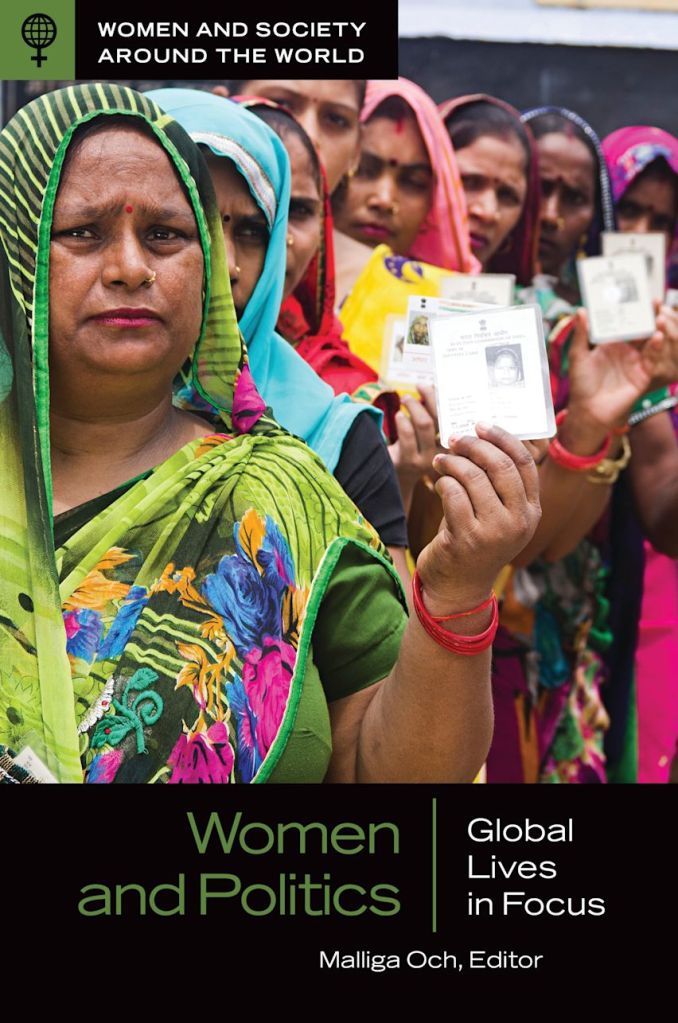
Focusing on the distinct identities and diverse lived experiences of women in a wide range of countries and cultures, this book provides a comprehensive overview of women in local, regional, and national politics around the world.
Women and Politics takes on the historical challenges women have and continue to face, and the victories they have achieved, in political cultures and structures around the world. The introduction walks readers through the key issues, pressing concerns, and foremost questions that researchers confront in their studies of women in various political roles across the globe. The remainder of the book, divided into eight chapters, covers such topics as women’s suffrage, the status of women in politics today, women as national leaders, barriers to women’s political representation, and others. Leading experts and emerging scholars come together in this volume to ask and provide answers to the question of why gender parity is so important in politics. They answer that only women, who as a group have a distinct identity and lived experiences that differ from men’s collective identities and interests, can accurately represent themselves both at home and on the world stage.
Gender and Political Representation on the Right
My longest and most productive research project to date has centered on the intersection of political ideology and gender where I ask how parties on the right address the descriptive and substantive representation of women. I show that conservative parties fall into two distinct categories. First are parties that use feminist framings to achieve non-feminist goals, such as electoral gain, economic growth, or improving birth rates. I examine this strategic use of feminism by the Republican Party in the United States in my book chapter “The Feminization of the Grand Old Party?” (Praeger Press, 2018) as well as in my article on the Liberal Democratic Party in Japan (co-authored with Linda Hasunuma, Representation 2018). In contrast, the German Christian Democratic Union uses feminist framing in support of feminist goals such as corporate board quotas or equitable parental leave, as I detail in my article in Parliamentary Affairs (2018). In “Squaring the Feminist Circle. Feminist Labels vs. Feminist Behavior in the German Christian Democratic Union” (Politics, Groups, Identities 2021) I demonstrate that female members of the German Christian Democratic Union have embraced feminist goals while rejecting feminist labels.
Conservative Women
(2021) Och, M. & R. Williams. “Feminism, Identities, and the Substantive Representation of Women on the Right – Crafting a Global Dialogue.” Politics, Groups, Identities 10(1): 135–138
(2021) Och, M. “Squaring the Feminist Circle. Feminist Labels vs. Feminist Behavior in the German Christian Democratic Union.” Politics, Groups, and Identities 10(1): 157–160
(2020) Och, M. “Political Ambitions, Structural Obstacles, and the Fate of Republican Woman.” In Good Reasons to Run, ed. Shames et al. Temple University Press
(2020) Shames, S.; M. Och; R. Cooperman. “Sell-Outs or Warriors for Change? A Comparative Look at Rightist, Political Women in Democracies.” Journal of Women, Politics, and Policy 40(1): 1–6
(2019) Och, M. “Conservative Feminists? An Exploration of Feminist Arguments in Parliamentary Debates of the Bundestag.” Parliamentary Affairs 72(4): 353–378
(2018) Och, M. “The Grand Old Party of 2016: No Longer the Party of Old White Men?” In The Right Women, ed. Och & Shames. Praeger Press
(2018) Och, M. & L. Hasunuma. “Womenomics under Abe’s Leadership: Signs of Feminisation of Japan’s Liberal Democratic Party?” Representation 54(2): 177–193
Sell-Outs or Warriors for Change? (2023)
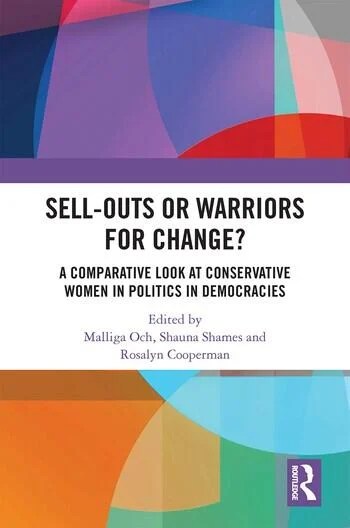
This book addresses the central question of how right-wing women navigate the cross-pressures between gender identity and political ideology.
The hope has always been that more women in politics would lead to greater inclusion of women’s voices and interests in decision-making and policy. Yet this is not always the case; some prominent conservative women such as Margaret Thatcher have rejected the feminist label while others such as Angela Merkel have reluctantly accepted it. Republican women in the U.S. Congress have embraced social and economic policies contrary to what many consider to be women’s issues while EU Commission president Ursula von der Leyen is a staunch supporter of feminist ideas. Other conservative women, such as Marine LePen in France strategically use feminist ideas to justify their conservative stances on immigration. This brings up an interesting yet understudied question: under what circumstances do conservative women become feminist allies and when do they toe the party line? It is this tension between women’s political representation and conservatism that this edited volume explores.
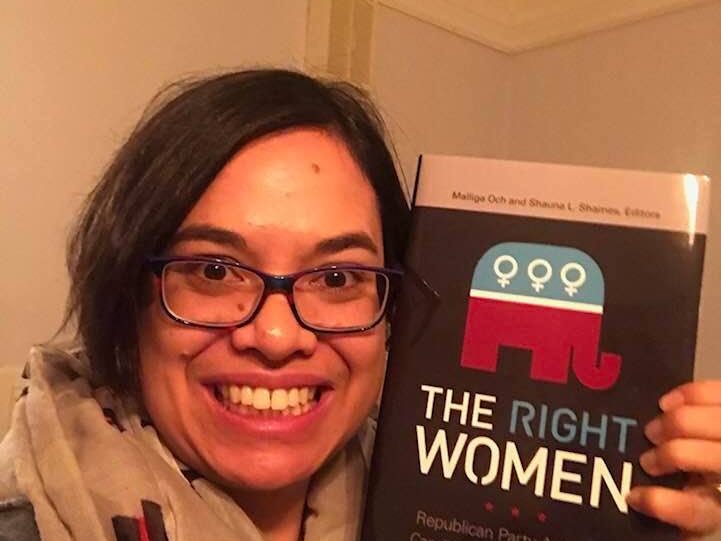
The Right Women (2018)
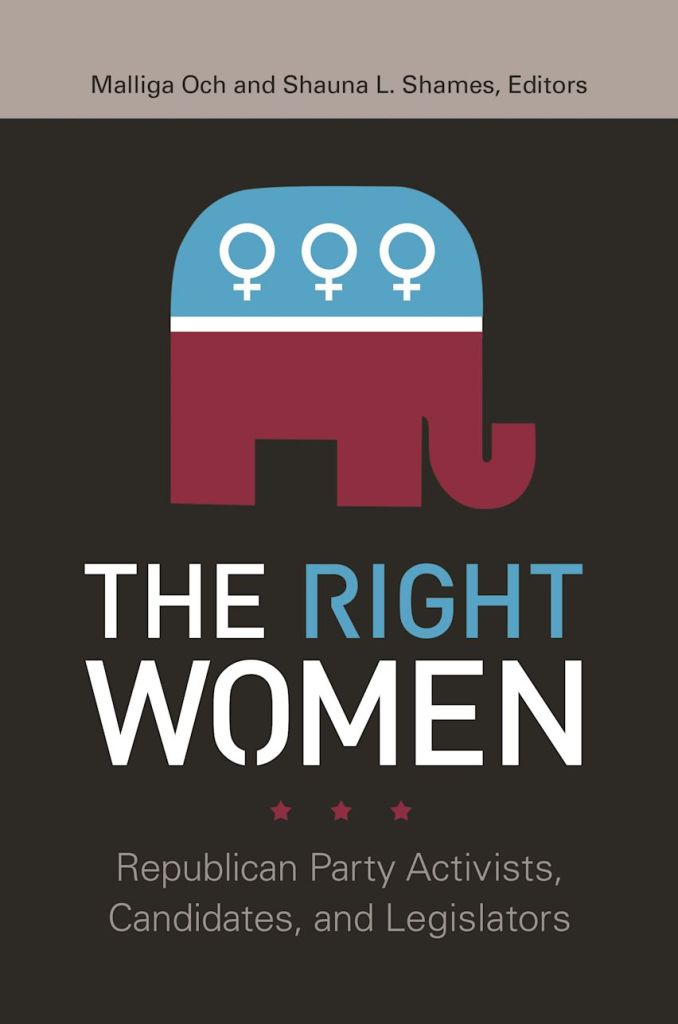
A powerful exploration of the role of women in the Republican Party that enhances readers’ understanding of gender representation in the GOP and suggests solutions to address the partisan gender gap.
Why is the Republican Party dominated by men to a far greater extent than its primary rival? With literature on conservative women in the United States still in its infancy, this book fills an important gap by examining Republican women as distinct from their male Republican and Democratic female counterparts while also exploring the shifting role of Republican women in their party and in politics overall. The Right Women brings those subjects together in one volume that will provide fascinating reading to students, scholars, and anyone else interested in U.S. politics.
The analysis is presented in four parts, beginning with a look at the role of women as voters and activists in the GOP. The second section explores the process of candidate emergence, tackling the question of why so few women run as Republicans and why those who do are less successful than their Democratic female and Republican male counterparts. In the third part, the contributors shed light on Republican women in Congress and state legislatures and their behavior as lawmakers. The final section assesses the outcome of the 2016 election for Republican women in general and, specifically, for Carly Fiorina, the only female candidate for the Republican presidential nomination. Each section of the book concludes with a short “guide to action” that takes the insights set forth and applies them to suggest ways to promote a greater involvement of women in the Republican Party.
Gender and Leadership
My research interest on women as prime ministers and presidents emerged during the pandemic when popular outlets started to praise women leaders for their handling of COVID-19 . My coauthors and I asked ourselves: did women really act differently and if so, did women pay greater attention to the needs of women during the pandemic? In our 2021 Working Paper for UN Women, Jennifer Piscopo and I show that women leaders responded similarly to the pandemic by being adept crisis managers and effective communicators, deploying containment measures more rapidly, and creating policies that were more socially inclusive. In our second publication for Gender and Development, we illustrate that local women leaders specifically paid much greater attention to the needs of women during the pandemic such as access to sanitary products during lockdowns or designating women shelters as critical infrastructure.
Together with Farida Jalalzai and Louise Davidson-Schmich, we wondered whether women leaders were perceived so positively because COVID19 was a health crisis which triggered associations of women as healers, nurturers, and carers. Specifically, we assumed that when crises create gender role congruency for women leaders, they will be perceived positively by the public. We published the foundation of this theory in Politics and Gender in 2023. . The article forms the basis for our most recent book Gender, Crisis and Leadership – Possibilities and Perils for Women Leaders. In the book, we ask how sudden crises shape the perception of women as capable leaders. We argue that the relationship between crisis and gender is conditional. When crises produce gender role congruency for women leaders, their leadership is likely to be evaluated positively, strengthening the view of women as capable leaders. In contrast, crises can also create gender role incongruity for women leaders, exacerbating backlash and reinforcing the view that women are not fit to be leaders. We test our theory across a feminized crisis (COVID-19), a gender-neutral crisis (natural disasters), and masculine crises (domestic terrorist attacks) using Chancellor Angela Merkel of Germany and Prime Minister Jacinda Ardern of New Zealand as our case studies as both leaders had to confront all three types of crises while in office.
Women Leaders
(2023) Davidson-Schmich, L., F. Jalalzai, M. Och. “Crisis, Gender Role Congruency, and Perceptions of Executive Leadership.” Politics & Gender
(2021) Piscopo J. and M. Och. “Effective, Decisive, and Inclusive: Women’s Leadership in COVID-19 Response and Recovery,” Working Paper for UN Women.
Gender, Leadership and Crisis (2026)
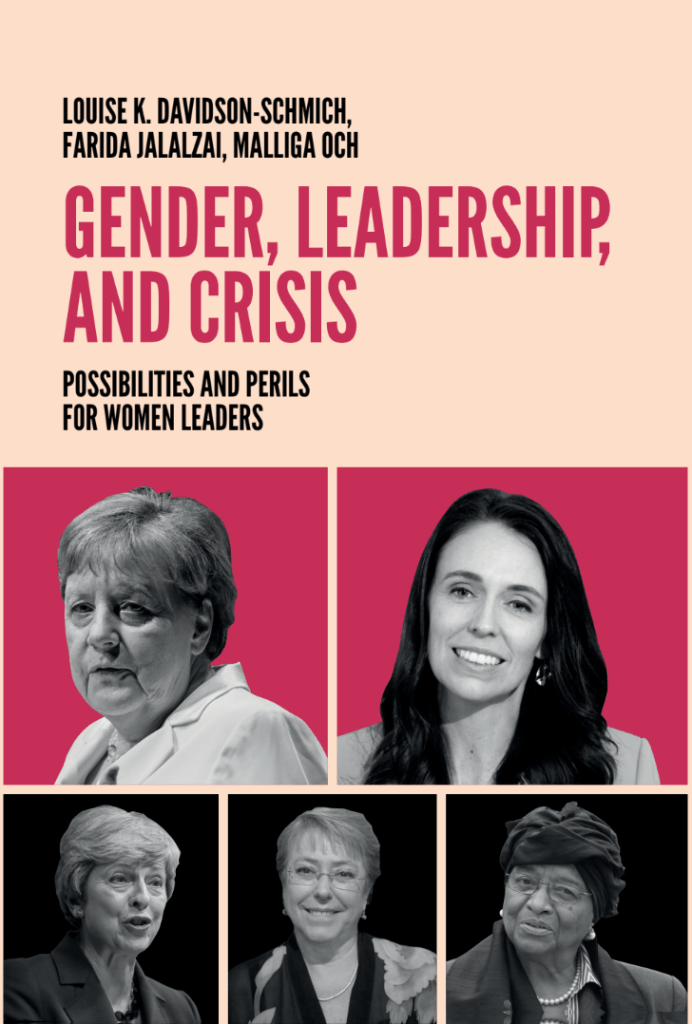
Why are some women leaders hailed as brilliant crisis managers while others draw widespread criticism? This book unpacks the circumstances under which women leaders can successfully navigate major crises. Gender, Leadership, and Crisis shows that gender role expectations can make or break a leader’s reputation.
Crises provide opportunities for women leaders to exhibit their leadership capacities if they act in accordance with gendered expectations. When women leaders act contrary to gendered expectations, it reinforces the idea that women are unfit leaders; to be considered successful crisis managers, women leaders should frame events in feminized terms, act collaboratively, and demonstrate empathy and meaning making rather than giving orders. The book focuses on how German Chancellor Angela Merkel and New Zealand Prime Minister Jacinda Ardern handled three kinds of crises: a gender-congruent crisis (COVID-19 pandemic), gender- neutral crises (natural disasters), and gender-incongruent crisis (nationalist terrorist attacks). These primary case studies are supplemented with chapters about Liberian President Ellen Johnson Sirleaf (Ebola epidemic), Chilean President Michelle Bachelet (27/F earthquake), and British Prime minister Theresa May (Manchester Stadium bombing). Most importantly, we show that women leaders can be perceived positively in a time of crisis when they act in line with gendered expectations.
Human Rights Cities
This research project focuses on the rise of human rights cities, particularly the Cities for CEDAW Campaign which encourages U.S. cities and counties to adopt a CEDAW ordinance or resolution to incorporate the principles of the Convention on the Elimination of All Forms of Discrimination (CEDAW) – elimination of sex-based discrimination and promotion of gender equality – into local legal code. My research explores the motivation behind the adoption and diffusion of human rights at the local level. In my 2018 article, I show how CEDAW cities have localized international norms to resonate with and respond to local concerns and issues (International Feminist Journal of Politics Politics). My policy report Denver for CEDAW (2018) for the United Nations Association Denver, which I co-authored with a student of mine at Idaho State University, detailed the implementation process of CEDAW ordinances in seven CEDAW cities and assessed the feasibility of a CEDAW ordinance for Denver. My 2022 article argues that the majority of CEDAW ordinances and resolutions act mostly as signals for women-friendly cities rather than as a policy plan for real change (Journal of Human Rights Practice 2022). My 2025 article (Human Rights Review) with Edward Kammerer shows that while cities with legally binding CEDAW ordinances tend to be more Democratic and have larger populations, the entire universe of CEDAW cities contains significant variation. This matters because it means that human rights efforts can be successful in a wide variety of places thus bringing the protection of CEDAW and gender equality tools to a broad range of people.
Gender and Human Rights
(2025) E. F. Kammerer Jr and M. Och. “Understanding CEDAW Cities. A descriptive Analysis.” Human Rights Review 25: 443–462.
(2022) Och, M. “Moral Urbanism and the Cities for CEDAW campaign in the United States.” Journal of Human Rights Practice: 1–22
(2021) Och, M. & S. Zwingel. “International Law and Human Rights.” In Political Science is for Everyone. An Intersectional Introduction, ed. Amy Atchison. University of Toronto Press.
(2018) Och, M. “The local diffusion of international human rights norms – understanding the cities for CEDAW campaign.” International Feminist Journal of Politics 20(3): 425–443

Contact Me
ochm [at] denison.edu
100 W College St
Granville OH 43023
 Malliga Och, PhD